 By Sky Bloom IT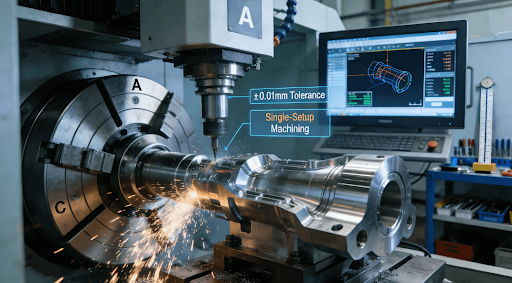
File name: 5-axis-cnc-machining-aerospace-titanium-part.jpg
Introduction
In modern manufacturing, engineers and designers face escalating challenges in producing high-performance components such as aerospace structures and medical implants. These parts often feature complex geometries like free-form surfaces and deep cavities, which traditional 3-axis CNC machining struggles to handle efficiently due to limitations in precision and multiple setups. This inefficiency leads to increased errors and costs, hindering innovation and iteration speed.
This article explores how 5-axis CNC machining technology addresses these issues through single-setup processing and smart manufacturing principles, offering a viable solution for precision engineering. By integrating advanced kinematics and digital tools, it enables manufacturers to achieve higher accuracy and efficiency.
What Are the Key Limitations of Traditional 3-Axis CNC Machining in Complex Geometry Processing?
Traditional 3-axis CNC machining is adequate for simple parts but falls short with complex designs due to inherent constraints. This section details key bottlenecks that impact accuracy and efficiency, highlighting why upgrades are essential for modern demands.
- Cumulative Errors from Multiple Setups: The need for repeated repositioning in 3-axis machining introduces cumulative errors, as each setup can misalign the workpiece by up to 0.05 mm. This accuracy degradation is critical for parts requiring tight tolerances, such as those governed by standards like ASME Y14.5, which defines geometric dimensioning rules. For instance, in aerospace components, multiple fixtures amplify deviations, leading to scrap rates of 10-15%. In contrast, 5-axis technology minimizes these errors through integrated workflows, ensuring consistency. This underscores the importance of single-setup solutions for precision-critical industries.
- Tool Vibration and Thin-Wall Deformation: Limited tool access in 3-axis systems causes excessive vibration during deep cavity machining, leading to deformation in thin-walled sections below 1 mm thickness. This issue compromises structural integrity and surface finish, often necessitating post-processing like hand polishing, which increases costs by 20%. For example, in medical implant production, vibration-induced distortions can render parts non-compliant with ISO 13485 standards. 5-axis machining mitigates this with dynamic tool orientation, reducing vibration through optimal cutting angles. This results in improved part quality and reduced rework.
- Inefficiency in Geometric Freedom: The linear motion of 3-axis machines restricts toolpath optimization, resulting in inefficient cutting patterns and longer cycle times. For instance, ball-end tools must operate at minimal step-overs to maintain surface quality, increasing machining time by up to 50% for free-form shapes. This inefficiency is evident in prototypes, where delays impact time-to-market. Additionally, limited accessibility forces designers to split complex parts, adding assembly steps. 5-axis systems enable continuous tool engagement, enhancing efficiency for complex shapes and supporting innovative designs.
How Does 5-Axis CNC Machining Enable Single-Setup Multi-Faceted Processing for Custom Parts?
5-axis CNC machining incorporates two rotational axes (e.g., A and C), allowing dynamic tool orientation for comprehensive processing in a single setup. This capability transforms manufacturing by eliminating repositioning errors and streamlining production for custom parts.
1. Principles of Multi-Axis Kinematics
The integration of rotary axes enables the tool to approach the workpiece from virtually any angle, facilitating simultaneous machining of multiple facets. For example, in turbine blade production, this reduces setup changes from three to one, cutting processing time by over 30% while maintaining sub-0.01 mm precision. The kinematics involve synchronized movements where axes adjust in real-time to maintain optimal cutting conditions. This reduces idle time and enhances surface finish quality, making it ideal for high-value components. Advanced controllers ensure smooth interpolation, minimizing tool wear.
2. Enhanced Accessibility for Deep Features
With 5-axis CNC machining service, tools can access deep cavities and undercuts without collision, avoiding the need to split complex parts. This streamlines the production of monolithic components like impellers, improving design integrity and reducing assembly steps. Case studies show cycle time reductions of 40% compared to 3-axis methods, as tools use flank milling for efficient material removal. For instance, in automotive industries, this allows for complex cooling channels in molds that were previously unachievable. This accessibility supports lightweighting trends in sectors like aerospace.
3. Case Study: Efficiency in Automotive Components
A practical application involves an automotive mold insert, where 5-axis machining completed the part in one setup within 11 hours, versus 18 hours with 3-axis processing. This demonstrates tangible cost savings of 30% and highlights the value of services offering custom complex parts through advanced technology. The process eliminated three fixture designs, reducing upfront costs by 25%. Moreover, dimensional accuracy improved to within ±0.02 mm, meeting strict OEM specifications. Such efficiencies make 5-axis ideal for high-mix, low-volume production, accelerating product development cycles.
A practical application involves an automotive mold insert. Using 5-axis machining, the part was completed in one setup within 11 hours, compared to 18 hours with 3-axis processing. This demonstrates tangible cost savings of 30% and highlights the value of services offering custom 5-axis machined complex parts through advanced technology.
What Core Capabilities Beyond Equipment Should a High-Quality 5-Axis Machining Provider Possess?
Owning advanced machinery is insufficient; providers must excel in supporting competencies like CAM programming and quality management to ensure reliability and consistency for clients.
- Advanced CAM Programming and Simulation: Software such as Siemens NX generates optimized toolpaths that prevent collisions and ensure smooth transitions. Providers with expertise in simulation tools can reduce scrap rates by up to 25%, adhering to standards like ISO 9001 for consistent outcomes in precision engineering. For example, virtual testing identifies interference risks before machining, saving time and materials. Additionally, post-processor customization tailors code to specific machine controllers, maximizing performance. This capability is crucial for complex geometries, where even minor errors cause failures.
- Custom Fixturing and Process Design: Tailored fixturing solutions are crucial for stable workpiece holding, especially for irregular geometries. High-quality providers use modular fixtures to minimize costs and setup time, enhancing flexibility for low-volume production. For instance, vacuum chucks or hydraulic systems secure parts without distortion, critical for thin-walled components. Process documentation ensures repeatability, with detailed workflows that reduce human error. This approach aligns with lean manufacturing principles, cutting waste by 15% and supporting just-in-time delivery for clients.
- Integrated Quality Assurance Systems: Robust quality systems, including in-process monitoring with probes, enable real-time error correction. Providers certified to AS9100D embed these practices to meet aerospace demands, ensuring traceability and compliance. For example, on-machine probing checks critical dimensions mid-process, allowing adjustments that hold tolerances within ±0.01 mm. Data logging creates audit trails for regulatory submissions, essential in medical sectors. This integration reduces final inspection time by 40%, delivering parts that meet stringent standards consistently.
How Can Smart Manufacturing Principles Enhance Efficiency in 5-Axis CNC Projects?
Smart manufacturing leverages IoT and data analytics to optimize 5-axis CNC operations, aligning with frameworks like the NIST Smart Manufacturing program for scalability and sustainability.
1. Real-Time Monitoring and Adaptive Control
Sensors collect data on tool wear and thermal drift, enabling predictive maintenance that cuts downtime by 20%. For instance, adaptive control adjusts feed rates based on cutting forces, maximizing tool life and maintaining precision. In one case, vibration sensors detected anomalies early, preventing a spindle failure that would have cost $10,000 in repairs. Cloud connectivity allows remote monitoring, giving managers insights into machine utilization. This data-driven approach supports proactive decisions, boosting overall equipment effectiveness (OEE) by 15%.
2. Data Traceability for Compliance
Digital records of machining parameters support regulatory adherence in industries like medical devices. Integrating with MES (Manufacturing Execution Systems) ensures full traceability, as advocated by National Institute of Standards and Technology (NIST) guidelines for smart factories. For example, each part can be tracked from raw material to shipment, with data stored in blockchain-like systems for security. This is critical for recalls or audits, reducing compliance risks. Automated reporting saves administrative time, allowing staff to focus on value-added tasks rather than manual documentation.
3. Digital Twin Integration
Using digital twins to simulate workflows reduces trial runs, saving up to 15% in energy consumption. This approach exemplifies how smart manufacturing principles drive efficiency in complex part production. For instance, a digital replica of a 5-axis setup can test toolpaths virtually, identifying bottlenecks before physical machining. This reduces material waste and shortens lead times. Integration with ERP systems enables real-time scheduling adjustments, optimizing resource allocation. Companies adopting this see a 20% improvement in on-time delivery rates.
What Are the Real-World Applications of 5-Axis CNC in Aerospace and Medical Industries?
5-axis CNC machining delivers critical benefits in high-stakes sectors, where precision and reliability are non-negotiable for safety and performance.
1. Aerospace: Turbine Blade Manufacturing
For aerospace components like turbine blades, 5-axis machining achieves surface roughness below Ra 0.4 and dimensional accuracy within ±0.01 mm. This results in 98% yield rates, meeting AS9100D standards for safety-critical parts. The technology handles heat-resistant alloys like Inconel, using high-speed machining to reduce cycle times by 35%. Additionally, single-setup processing ensures consistent airfoil profiles, enhancing engine efficiency. This application demonstrates how 5-axis supports lightweight, high-strength designs in aviation.
2. Medical: Implant Production
In medical applications, such as orthopedic implants, the technology enables complex contouring for biocompatible materials like titanium. This reduces manual finishing and ensures compliance with ISO 13485, improving patient outcomes. For example, patient-specific implants are machined with anatomical accuracy, cutting surgery time by 25%. Sterilizability requirements are met through precise surface finishes that minimize bacterial retention. The flexibility of 5-axis allows small batches, supporting personalized healthcare trends without sacrificing cost-effectiveness.
3. Cross-Industry Efficiency Gains
In multiple sectors, integrating multiple components into a single unit can reduce assembly costs by 30%. Suppliers demonstrate these advantages through case studies, such as integrating cooling channels into the mold. This reduces the number of parts and potential points of failure, improving product reliability. The solution’s scalability allows it to transition from prototyping to mass production, meeting the needs of diverse customers. This interoperability is key to driving innovation in smart factories.
How to Achieve Cost-Effectiveness in 5-Axis CNC Projects Through DFM Analysis?
Design for Manufacturability (DFM) analysis optimizes part designs to reduce costs without compromising quality, leveraging industry best practices and collaborative engineering.
- Standardizing Design Features: By standardizing elements like fillet radii and tolerance bands, DFM cuts machining time by 25%. This approach is supported by resources like Society of Manufacturing Engineers (SME) guidelines for efficient product development. For instance, unifying hole sizes reduces tool changes, while avoiding sharp corners minimizes stress concentrations. Early collaboration between designers and manufacturers identifies optimizations before prototyping, preventing costly revisions. This proactive step can lower total project costs by 20%, making high-precision machining more accessible.
- Material and Process Optimization: Selecting appropriate materials and cutting parameters minimizes waste. For example, optimizing feeds and speeds for aluminum alloys can reduce costs by 15% while maintaining precision. DFM analysis might recommend alternative materials like composites for weight savings, or suggest heat treatment steps to enhance durability. Supply chain integration ensures material availability, avoiding delays. This holistic view balances performance with economics, crucial for competitive pricing in custom part manufacturing.
- Case Example: Prototyping Savings: In prototyping, DFM analysis avoids unnecessary tooling, enabling low-volume production with lead times under three days. This makes 5-axis CNC ideal for rapid iteration, as highlighted in online CNC machining quote services. A real-world example saw a client reduce prototype costs by 40% by simplifying undercuts and standardizing tolerances. Digital twins validate designs early, cutting trial runs. This efficiency allows startups to iterate quickly, accelerating time-to-market for innovative products.
Conclusion
5-axis CNC machining technology resolves core manufacturing challenges through precision engineering and smart integration. By enabling single-setup processing, advanced toolpath optimization, and rigorous quality control, it enhances efficiency, accuracy, and cost-effectiveness. As industries adopt these innovations, they pave the way for smarter manufacturing ecosystems that support faster innovation and sustainable growth.
FAQs
Q: How long does it take to get a quote for a custom 5-axis CNC project?
A: Typically, a detailed quote with DFM analysis is provided within 8 working hours after submitting design files. This includes cost breakdowns and optimization suggestions to accelerate decision-making.
Q: Can 5-axis machining handle materials like titanium or composites?
A: Yes, advanced 5-axis systems support engineering materials including titanium, Inconel, and carbon composites. Process controls like temperature management ensure material integrity during machining.
Q: What is the typical accuracy achievable with 5-axis CNC for complex parts?
A: Precision can reach ±0.01 mm for features like turbine blades, achieved through real-time compensation technologies adhering to standards like ASME Y14.5.
Q: How does 5-axis machining reduce costs compared to traditional methods?
A: By eliminating multiple setups and tool changes, it cuts machining time by up to 40% and reduces scrap rates, as seen in aerospace case studies with 30% cost savings.
Q: Is 5-axis CNC suitable for low-volume prototyping?
A: Absolutely. Its single-setup capability avoids dedicated tooling, making it ideal for prototypes. Lead times can be as short as 1-3 days, balancing speed and quality.
Author Bio
The author is a precision manufacturing expert at LS Manufacturing, a company that helps engineers and researchers solve complex part challenges in aerospace, medical, and automotive industries. With certifications such as IATF 16949 and AS9100D, the team ensures high-quality solutions through advanced technologies. For more insights, contact them today for a free, no-obligation project review and DFM analysis.